|
Bearing installation
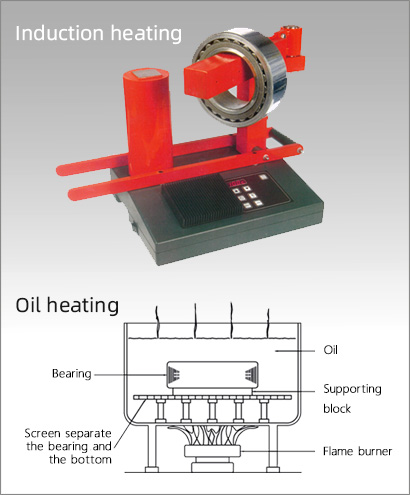
Precautions for bearing installation Keep the bearings and their surrounding environment clean, even if tiny dust that is not visible to the naked eye enters the bearings, it will increase the wear, vibration, and noise of the bearings. When using and installing, it is necessary to be careful and careful. Strong stamping is not allowed, and it is not allowed to directly strike the bearing with a hammer or transmit pressure through rolling elements. Use appropriate and accurate installation tools, try to use specialized tools, and avoid using fabrics and short fibers as much as possible. To prevent bearing corrosion, when taking the bearing directly by hand, the sweat on the hands should be thoroughly washed off and coated with high-quality mineral oil before operation. Rust prevention should be particularly emphasized during the rainy and summer seasons. Bearing installation method Heating method: It is recommended to use an induction heater for uniform, efficient, and clean heating. Oil heating method: 1. Do not exceed 120 ℃ for heating bearings. 2. To avoid direct contact with the bottom of the oil tank, place the bearing on a metal mesh or hang it up. 3. To avoid installation difficulties caused by inner ring cooling during operation, the bearing can be heated to a temperature 20 ℃ to 30 ℃ higher than the required temperature. 4. After installation and cooling down, there will be axial shrinkage. To avoid gaps between the inner ring and the shaft shoulder, nuts on the shaft or other appropriate methods can be used to tighten them. Common problems with bearing installation Ask: Are there any requirements for the installation surface and installation site? Q: Is it better to apply more grease when lubricating bearings? Answer: Yes. If there are foreign objects such as iron filings, burrs, dust, etc. entering the bearing, it will cause noise and vibration during operation, and even damage the raceway and rolling elements. So, before installing bearings, you must ensure that the installation surface and environment are clean. Ask: Do bearings need to be cleaned before installation? Answer: The surface of the bearing is coated with anti rust oil. You must carefully clean it with clean gasoline or kerosene, and then apply clean high-quality or high-speed high-temperature lubricating grease before installation and use. The cleanliness has a significant impact on the lifespan and vibration noise of bearings. But we would like to remind you that fully enclosed bearings do not require cleaning or oiling. Ask: How to choose lubricating grease? Answer: Lubrication has a crucial impact on the operation and lifespan of bearings. Here is a brief introduction to the general principles for selecting lubricating grease. Lubricating grease is made from base oil, thickeners, and additives. The performance of different types and grades of lubricating grease varies greatly, and the allowable rotation limit is different. It is important to pay attention to this when selecting. The performance of lubricating grease is mainly determined by the base oil. Generally, low viscosity base oils are suitable for low temperatures and high speeds; High viscosity is suitable for high temperatures and high loads. Thickener is also related to lubrication performance, and the water resistance of thickener determines the water resistance of lubricating grease, which has a negative impact on each other. Water based. In principle, different brands of lubricating grease cannot be mixed, and even lubricating grease with the same thickener can have negative effects on each other due to different additives. Ask: Is it better to apply more grease when lubricating bearings? Answer: When lubricating bearings, it is a common misconception to apply as much grease as possible. Excessive grease in bearings and bearing chambers will cause excessive mixing of grease, resulting in extremely high temperatures. Ask: How to install and disassemble? Answer: During installation, do not directly hammer the bearing end face and non stress surface. Instead, use pressure blocks, sleeves, or other installation tools to evenly force the bearing. If lubricating oil is applied to the installation surface, it will make the installation smoother. If the interference fit is large, the bearing should be placed in mineral oil and heated to 90-100 ℃ Install immediately afterwards. When encountering difficulties during disassembly, it is recommended that you use a disassembly tool to pull outward while carefully pouring hot oil onto the inner ring. The heat will cause the bearing inner ring to expand, making it more prone to detachment. Ask: Is it better to have a smaller radial clearance of the bearing? Answer: Not all bearings require a minimum working clearance, you must choose the appropriate clearance according to the conditions. In the national standard 4604-93, the radial clearance of rolling bearings is divided into five groups - Group 2, Group 0, Group 3, Group 4, and Group 5. The clearance values are in descending order, with Group 0 being the standard clearance. The basic radial clearance group is suitable for general operating conditions, conventional temperatures, and commonly used interference fit; Bearings that operate under special conditions such as high temperature, high speed, low noise, and low friction should have a large radial clearance; It is advisable to use bearings with smaller radial clearance for precision spindles and machine tool spindles; Roller bearings can maintain a small amount of working clearance. In addition, there is no clearance for separated bearings; Finally, the working clearance of the bearings after installation should be smaller than the original clearance before installation, because the bearings have to bear a certain amount of load rotation, as well as the elastic deformation caused by bearing fit and load. |