|
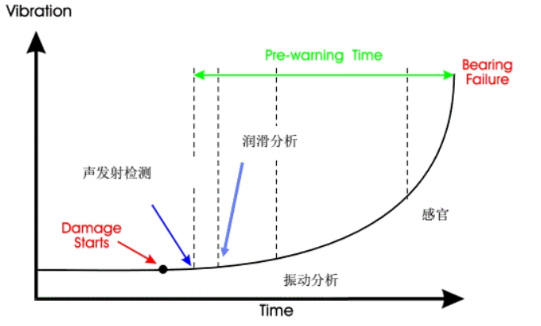
The development process and stages of classic bearing faults1、 Process changes of bearing failure The deterioration of bearing faults does not follow a linear pattern, but rather an exponential pattern, as shown in the following figure:
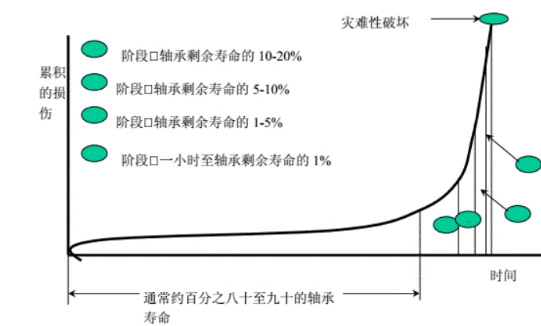
2、 Development stage of bearing failure
1. Initial stage The noise is normal; Normal temperature; Ultrasonic, vibration peak energy, and acoustic emission measurements can be used to detect defects in the outer ring of the bearing; The total amount of vibration is relatively small, and there are no discrete peaks in the frequency of bearing faults; The remaining lifespan is greater than 10%. 2. The noise slightly increases in the second stage; Normal temperature; Ultrasound, acoustic emission, significant increase in vibration peak energy, and defects in the outer ring of the bearing; The total amount of vibration slightly increases (total amount of vibration acceleration and total amount of vibration velocity); The bearing fault frequency can be clearly seen on the logarithmic scale spectrum, but it is rare to see it on the linear scale spectrum, and the noise level is significantly improved; The remaining lifespan is 5%. 3. Phase Three Audible noise; The temperature slightly increases; Very high ultrasound, acoustic emission, vibration peak energy, and bearing outer ring malfunction; There is a significant increase in the total amount of vibration acceleration and vibration velocity; Clearly identify the bearing fault frequency, its harmonics, and sidebands on the linear scale spectrum; The vibration spectrum noise level is significantly improved; The remaining lifespan is less than 1%. 4. Phase Four Changes in the intensity of noise; The temperature has significantly increased; Ultrasound, acoustic emission, and vibration peak energy rapidly increase and then gradually decrease, and the outer ring of the bearing is in a faulty state before damage; The total vibration velocity and displacement significantly increase, while the total vibration acceleration decreases; The vibration peaks dominated by lower bearing failure frequencies have very high noise levels in the vibration cheek spectrum; The remaining lifespan is less than 0.2%. |